Visual perception tests

Subjects performed a series of psychophysical tasks which have been employed in previous studies with the intention of targeting visual function within either the magnocellular (M) or parvocelluar (P) visual pathways.

Equipment: Experimental procedures and stimulus generation were controlled by a Macintosh computer (Apple Computer Ltd). Experiments were run under the MatLab programming environment (Mathworks Ltd). Software for display calibration and stimulus display contained elements of the VideoToolbox and PsychToolbox software packages. Stimuli were displayed on a 19" Sony Trinitron CRT monitor operating at a screen resolution of 1024 X 768 pixels with a frame refresh rate of 85Hz. The RGB outputs from the built-in Macintosh graphics card were attenuated and combined in hardware to give psuedo-12 bit contrast accuracy . This combined signal was amplified and copied to all three guns of the monitor to produce monochrome images. Display output was calibrated using a Minolta LS100 photometer (Minolta UK Ltd) and then linearised in software using look-up tables. The calibrated display was capable of displaying images between 0 and 100cd m2.

Subjects viewed the screen binocularly at a viewing distance of 228 cm for the acuity experiment, and 114 cm for all other conditions. Under these conditions one pixel subtends 0.5 and 1.0 minutes of arc respectively. Subjects always fixated the centre of the screen aided by the presence of a continuously visible fixation marker. Subjects made all responses on a numeric keypad clearly marked with available choices.

Experimental procedure: An adaptive psychophysical staircase procedure was used to estimate thresholds in all but the Ternus condition. QUEST works by sampling a range of cue levels and using subjects’ responses, in combination with a Bayesian estimator, to attempt to converge on the cue-level yielding 83% correct performance on the task. Unless stated otherwise, runs consisted of blocks of 45 trials and at least three runs were undertaken for each data point plotted. Since QUEST is based on a staircase individual trials are not independent of one another, and we ensured that runs always commenced with several "easy" trials. Catch trials were not used. Runs were not interleaved; each run for each condition was performed separately and was preceded by a short explanation of the task at hand. Data were pooled across all runs within each condition; error bars show the estimated standard error. Feedback, in the form of an audible beep was used to indicate errors in all but the (subjective) Ternus task.

Visual acuity
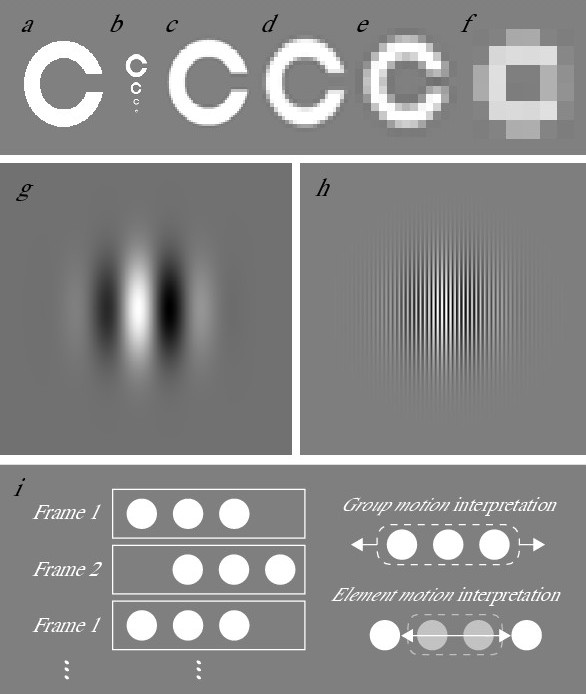
Visual acuity is generally thought to be normal amongst dyslexics. Evidence from a study of 253 dyslexic school children, drawn from a test population of more than 2500, indicates that they fall into the normal range for a range of ophthalmological tasks probing acuity, ocular movement, convergence, fixation, accommodation, etc. However, since it is necessary to establish normal acuity before being able to interpret the results of other psychophysical estimated visual acuity using a letter orientation discrimination task. Subjects were presented with a Landolt C (see Figure a), centred on their point of fixation, at one of four orientations (0°, 90°, 180° or 270° rotation). The letters appeared white (100 cd/m2) on a grey (50 cd/m2) background. By convention, the thickness of the stroke forming the C is 1/5 of the letter diameter as is the height of the gap. Subjects performed a single-interval four-alternative forced choice (4AFC): to report the orientation of the letter using the keypad. Stimuli were presented for a total of 500 ms and were smoothly ramped on and off with a Gaussian contrast envelope (s=200 ms.) to minimise the contribution of transients at the stimulus onset and offset.

The basic stimulus diameter was 150 pixels (75 arc min.) but images were scaled, using bilinear linear interpolation, to manipulate the difficulty of the task (Figure a-f). The scaling factor supporting 83% identification of letter orientation was determined using the adaptive psychophysical procedure described above. This value was converted into an equivalent ‘C’ gap-size (expressed in arc min.) to produce a measure of visual acuity known as the minimum angle of resolution (MAR). MAR can straightforwardly be converted to more familiar estimates of acuity such as Snellen acuity (Snellen acuity in metres = 6/6*MAR, in feet = 20/20*MAR). Normal visual acuity is thus defined as an MAR of 1.0 arc min or a Snellen acuity of 6/6 (or 20/20 expressed in feet). Figure b-e shows example stimuli which have been scaled by (b) 26.7, (c) 13.3, (d) 6.7% and (e) 3.3% corresponding to Snellen acuities of 6/24, 6/12, 6/6 (normal) and 6/3 respectively. Below each of the scaled stimuli is an enlarged view demonstrating that the spatial resolution of the system as described is adequate to render legible stimuli at normal acuity limits.

The acuity estimates as presented are the mean within-subject thresholds based on at least three runs of 45 trials per subject.

Contrast sensitivity
Perhaps the most direct way to assess M- versus P-function is to measure differences in sensitivity to low-contrast stimuli designed to target each stream. A number of studies have interpreted such contrast sensitivity findings as supporting M-deficits in dyslexics (e.g. ; but see for a critical review and for other objections). However many such studies have been methodologically flawed either in terms of the spatial/temporal frequencies of stimuli employed or because, while some show poor dyslexic-performance on M-specific stimuli, few rarely establish normal performance with P-specific stimuli We sought to avoid these pitfalls and measured contrast sensitivity using a grating detection task. Stimuli were Gabor patterns: cosinusoidal gratings spatially windowed by an isotropic Gaussian contrast envelope (s=1.0 deg.; see Figure g,h). We tested two combinations of spatial and temporal frequency: magnocellular-selective (M-selective) stimuli had a peak spatial frequency of 0.5 cycles per degree (c/deg) and counter-phase flickered at a rate of 15 reversals per second, while parvocellular-selective (P-selective) stimuli had a peak spatial frequency of 8.0 c/deg and did not counter-phase flicker. Spatial frequency values were chosen to span the point at which psychophysical detection switches from transient to sustained mechanisms (~1.5 c/deg; .

Stimulus duration was 500ms. In order to minimise the impact of onset and offset transients in P-selective conditions, the contrast of all stimuli was smoothly ramped on and off with a Gaussian contrast envelope (s=200 ms.). In the M-selective conditions, stimulus contrast was modulated by a Gabor temporal envelope: a Gaussian envelope (s=200 ms.) multiplied by a sinusoid (l=66.7ms). This produces a spatially and temporally Gaussian-ramped grating smoothly phase-reversing at a rate of 15Hz. This flicker-rate was chosen to selectively target parvocellular function based on

To further target the magnocellular pathway we followed in making M-selective stimuli low-luminance, since it is known that M-pathway response is dominant at mesopic/scotopic light levels . M-selective stimuli therefore had a mean luminance of 5 cd/m2 (i.e. 0-10cd/m2) while P-selective stimuli varied around a mean luminance of 40 cd/m2 (i.e. 0-80cd/m2)

Subjects were presented with two intervals; one randomly selected interval contained a Gabor patch (with carrier in random phase), the other a blank field at background luminance. The subjects’ task was then to indicate which interval contained the grating (2AFC). The onset of each interval was indicated by an auditory cue, and intervals were separated by a 500ms ISI. QUEST was used to vary the Michelson contrast of targets until subjects were performing at 83% discrimination. Contrast detection thresholds are presented as percent Michelson contrast.

Speed discrimination
There is evidence that while poorer contrast sensitivity for M-selective stimuli may not reliably co-occur with dyslexia, poor speed discrimination might . , for example, showed that Weber fractions for speed discrimination (percentage higher speed required for discrimination from baseline) amongst dyslexics were elevated by about 50% compared to controls. We measured speed discrimination using versions of the stimuli similar we used to probe contrast detection (described in the last section) but with drifting carriers. The P and M-selective stimuli were tested with reference speeds of 1.0 and 16.0 deg/sec., and contrasts of 20% and 80% respectively. Speeds were selected both to target transient and sustained mechanisms, but also to produce equivalent temporal frequencies in terms of carrier-cycles per second (i.e. an M:P speed ratio of 16:1 and an M:P spatial frequency ratio of 1:16). Stimulus contrast was again enveloped using a temporal Gaussian function. However, in order to prevent subjects counting the number of bars passing, rather than judging speed, the standard deviation of the envelope was uniformly randomly varied between 160 and 240 ms. Neither class of stimulus flickered, but in all other respects (e.g. luminance differences) they were identical to the detection stimuli described above.

Subjects were presented with two intervals, both containing a Gabor patch with a carrier drifting randomly to the left or the right. In one randomly-selected interval the carrier moved at reference speed, in the other it moved slightly faster. Subjects indicated the interval in which the grating moved faster (2AFC). QUEST was used to estimate the percentage increase in speed over baseline required to perform this discrimination with 83% accuracy. Intervals were again separated by an ISI of 500ms and, although all stimuli were clearly visible, were also audibly pre-cued.

Coherent motion detection:
A number of studies have claimed that dyslexics are poorer at detecting coherent motion embedded in moving noise than normal controls and it has further been claimed that poor coherent motion detection correlates with poor letter position encoding . We sought to test these findings and broadly followed the methods of for generating stimuli. Subjects were presented with an 8° X 8° field of 150 randomly positioned dots (each subtending 1 arc min.), appearing white (100 cd/m2) on a grey background (50 cd/m2), and moving rapidly (11 deg./sec) to the left or the right. Stimulus movies lasted for 900ms and consisted of 19 distinct frames. Dots appeared for a maximum of 4 movie-frames before being randomly replaced (limited life-time elements) to minimize the possibility of subjects using tracking eye movements. Subjects performed a single-interval 2AFC task: to report whether the dots were moving, on average, to the left or the right. The difficulty of the task was manipulated (using QUEST) by replacing a proportion of elements with dots moving in a random direction (with the same lifetime, speed, etc.). The threshold estimate corresponds to the minimum proportion of coherently moving dots supporting 83% discrimination of direction.

Ternus task
A Ternus display consists of a looping two frame-movie, with each frame showing a triplet of co-aligned, equally spaced identical elements (e.g. disks). Frames differ in that the triplet jumps back and forth by a distance equal to the inter-element spacing so that two of the elements effectively never move. There are two possible perceptual interpretations: group motion (the triplet is jumping back and forth), or element motion (the centre two elements are stationary, and a single elements jumps from end to end). Long inter-stimulus-intervals (>50ms) tend to elicit a percept of group motion, whereas shorter ISIs elicit element motion. It has been proposed that this difference is due to selective targeting of the M and P systems (e.g. although Fourier analysis of typical Ternus stimuli is not wholely consistent with this idea . Their M- or P-specificity apart, it is known that Ternus stimuli are less likely to elicit percepts of group motion in dyslexics than goods readers a result that has also been confirmed with children .

We measured group versus element motion percepts in Ternus displays. Individual frames consisted of three horizontally co-aligned white discs (100 cd/m2; radii=0.5 deg.; separation=1.0 deg.) on a grey background (50 cd/m2). The two stimulus frames were each displayed for 47 ms. separated by a variable inter-stimulus interval. We used a 128-trial method of constant stimuli to sample ISIs of 12, 24, 36, 48, 60, 72, 84 or 96ms. Total movie length was restricted to 400ms. Subjects were required to report if they say element or group motion using the keypad. No feedback was given since this is an entirely subjective judgment. Probability data for each subject were fit with a cumulative Gaussian function to give an estimate of slope and bias. The bias parameter gives an estimate of the ISI producing a 50% probability of a report of global motion.

NB: results are not reported for the Ternus task because they were found to be very inconsistent, even within the control group. Many subjects only saw group motion, even at the shortest ISIs.
 
Figure. Stimuli from visual psychophysical tasks.
(a-f) Acuity stimuli. 
(a) Unscaled Landolt C.
(b) Reduced versions of (a) scaled using bilinear interpolation by factors of (top to bottom) 26.7%, 13.3%, 6.7% and 3.3%.
(c-f) Magnified versions of the elements of (b).
Normal visual acuity would produce threshold performance (using our experimental set-up) with stimuli like (e).
(g) M-selective and
(h) P-selective Gabor patches used to measure contrast sensitivity and speed discrimination performance.
(i) Schematic description of Ternus experiment.


References

Aasved H, 1987 "Ophthalmological ststus of school children with dyslexia" Eye 1 61-68

Braddick O J, 1980 "Low-level and high-level processes in apparent motion" Philosophical Transactions of the Royal Sociey of London B 290 137-151

Brainard D H, 1997 "The Psychophysics Toolbox" Spatial Vision 10 433-436

Cestnick L, Coltheart M, 1999 "The relationship between language-processing and visual-processing deficits in developmental dyslexia" Cognition71 231-255

Cornelissen P, Richardson A, Mason A, Fowler S, Stein J, 1995 "Contrast sensitivity and coherent motion detection measured at photopic luminance levels in dyslexics and controls [see comments]" Vision Research 35 1483-94

Cornelissen P L, Hansen P C, Gilchrist I, Cormack F, Essex J, Frankish C, 1998 "Coherent motion detection and letter position encoding" Vision Research 38 2181-91

Demb J B, Boynton G M, Best M, Heeger D J, 1998 "Psychophysical evidence for a magnocellular pathway deficit in dyslexia" Vision Research38 1555-9

Eden G F, VanMeter J W, Rumsey J M, Maisog J M, Woods R P, Zeffiro T A, 1996 "Abnormal processing of visual motion in dyslexia revealed by functional brain imaging [see comments]" Nature 382 66-9

Everatt J, Bradshaw M F, Hibbard P B, 1999 "Visual processing and dyslexia" Perception 28 243-254

Lee B B, Smith V C, Pokorny J, Kremers J, 1997 "Rod inputs to macaque ganglion cells" Vision Research 37 2813–28

Legge G E, 1978 "Sustained and transient mechanisms in human vision: temporal and spatial properties" Vision Research18 69-81

Martin F, Lovegrove W, 1987 "Flicker contrast sensitivity in normal an specifically disabled readers" Perception 16 215–221

Pelli D G, 1997 "The VideoToolbox software for visual psychophysics: transforming number into movies" Spatial Vision 10 437-442

Pelli D G, Zhang L, 1991 "Accurate control of contrast on microcomputer displays" Vision Research 31 1337-1350

Purpura K, Kaplan E, Shapley R M, 1988 "Background light and the contrast gain of primate P and M retinal ganglion cells" Proceedings of the National Acadeny of Science U.S.A. 85 4534–7

Raymond J, Sorenson R, 1998 "Visual motion perception in children with dyslexia: normal detection but abnormal integration" Visual Cognition 5 389-404

Skottun B C, 2000 "The magnocellular deficit theory of dyslexia: the evidence from contrast sensitivity" Vision Research40 111-27

Skottun B C, 2001 "On the use of the Ternus test to assess magnocellular function" Perception 30 1449-57

Slaghuis W L, Ryan J F, 1999 "Spatio-temporal contrast sensitivity, coherent motion, and visible persistence in developmental dyslexia." Vision Research 39 651-668

Slaghuis W L, Twell A, Kingston K, 1996 "Visual and language processing deficits are concurrent in dyslexia and continue into adulthood." Cortex 32 413-438

Stuart G W, McAnally K I, Castles A, 2001 "Can contrast sensitivity functions in dyslexia be explained by inattention rather than a magnocellular deficit?" Vision Research 41 3205-11

Talcott J B, Witton C, McLean M F, Hansen P C, Rees A, Green G G, Stein J F, 2000 "Dynamic sensory sensitivity and children's word decoding skills" Proceedings of the National Acadeny of Science U.S.A. 97 2952-7

Ternus J, 1938 "The problem of phenomenal identity", in A sourcebook of Gestalt psychology Ed D W Ellis (London: London)

Watson A B, Pelli D G, 1983 "QUEST: a Bayesian adaptive psychometric method" Percept Psychophys 33 113-20

Witton C, Talcott J B, Hansen P C, Richardson A J, Griffiths T D, Rees A, Stein J F, Green G G, 1998 "Sensitivity to dynamic auditory and visual stimuli predicts nonword reading ability in both dyslexic and normal readers" Current Biology 8 791-7